September 26, 2010

Jake 1 / Cancer 0

Jake 1 / Cancer 0
It was only a few short years ago that Jake Silberg and his parents were on vacation in Italy when he took ill. In the hospital they discovered that Jake was dealing with a form of blood cancer. He was in an Italian hospital for a number of weeks and then medivac-ed home where he was treated at Sloan Kettering.

Today Jake and his friend Ben Donald, both TSTI teens, participated in a triathlon in to raise money for blood cancer research. 
Here's Jake crossing the finish line.

I asked Jake what he thought would be a good caption for this picture and he responded, "Jake 1 / Cancer 0". Works for me!


September 11, 2010

A Rosh Hashannah D'var Torah on B'resheet...

We have wonderful teens here at TSTI. They are bright, kind and committed to tikkun olam. They are also quite thoughtful and inspiring... as this D'var Torah from TSTI teen, and STISY Religious and Cultural Vice-President, Mollie Weisenfeld shows...

(Note- this D'var Torah was delivered at the Erev Rosh Hashanah Teen Service. Our thanks to Mollie for allowing us to share it with the entire community.)
D’var on B’resheet
     L’shana tova.  The Torah portion for Rosh Hashanah is B’resheet, better known as the Story of Creation.  Over the course of six days, God creates heaven and earth, day and night, water and sky, land, vegetation, the sun and the moon, living creatures of land, sea, and sky.  God created humans-first Adam, then Eve, and placed them in the Garden of Eden.  On the seventh day, God rested, and this day was called Shabbat.  
     God created humans in God’s image.  This does not mean God’s physical likeness because God has no body or form.  Instead it means that we as people were given the powers of mind and reason-the ability to think about life and understand it on more than an instinctual level.  And because we are the only animals who can truly do this, God made us the guardians of our world.  Our choices make a difference in all the lives around us.  Humans are smart and creative.  But sometimes we go too far, and in creating for ourselves, we destroy for others; we hurt them-humans and different animals alike.
     We hurt animals with our actions against them and the environment they live in.  We cut down trees that house birds so that we can have paper or make homes of our own.  We dispense gases into the air in emissions from our factories.  Most recently, the BP oil spill has dumped anywhere from 92 million gallons to 327 million gallons of crude oil into Gulf since April 22nd.  (pbs.org)
     Humanity also hurts each other with words, actions, or inaction.  Angry fights, throwing insults, or allowing a bully to tease someone without interference all damage people.  If we are the guardians of our world, entrusted by God to aid all creations, how can we allow these tragedies occur?
     That is not to say that humanity is evil, because it’s not.  We are human and we make mistakes.  In giving us the power to think and take action, God gave us two options: the inclination to do good, yetzer ha-tov, and the inclination to do evil, yetzer ha-ra.  Though there are people who hurt the world and those who live here, there are also those who strive to make it a better place.  For example, there are activists who protest the cutting of rare trees, protect endangered species, and volunteer to clean up the destruction caused by natural disasters like earthquakes, though they were unaffected.  There are people who donate money to organizations that help sick, disadvantaged people all over the world.  Even right here at Temple, in STISY, we go on Midnight Run to give out clothes and food to the homeless.
     There are individual good deeds people do on their own: helping up someone who has fallen, rescuing a baby bird that left the nest too early, or just smiling at someone and saying hello.  These mitzvot don’t even have to help someone else.  When was the last time you did something just for yourself, something special that you knew you’d enjoy?  I know mine: I was at a writing camp in August.  The camp was located in Massachusetts in the middle of a forest.  My very first day there, I had noticed a trail going through the woods, but none of my friends were interested in exploring, so I didn’t go.  Finally, on the second to last day, while everyone else was packing, I got up the courage and went alone.  The hike took me about an hour and when I came out of the woods, I felt refreshed.  Happy.  I had gone for the walk because I wanted to, and with no one to talk to or entertain, I was able to focus wholly on myself and just reflect. 
     So this Rosh Hashanah, I would like you to do two things: take time out of your life to do something for another, and take time for yourself.  Go read up on the oil spill and learn how to help, if you want.  Call up your grandparents and tell them about your summer.  Smile at a stranger you pass on the street.  And when you’ve done that, do something just for you.  Watch a movie you’ve been meaning to see.  Sleep an extra hour on the weekend.  Bake a cake simply because you have the ingredients in the house.   Because when God created this world, God knew it wasn’t going to be perfect.  But we were put here to protect what had been made and better it.  God created us to help out.

September 9, 2010

Shofar Showdown?

A sweet 5771 to all!

And a huge thank you to David Leit for once again blowing shofar so magnificently.

But also a warning to you, David... you may be the reigning shofar-champ of TSTI but Emma Wishnow is coming on strong! It is looking like a shofar showdown may be in the congregation's future...

September 2, 2010

Bar Mitzvah Redux


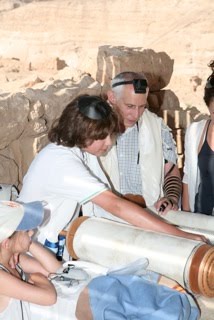
Ethan Gelman, one of TSTI's B'nai Mitzvah last year just returned from a trip to Israel with his family where he became Bar Mitzvah a second time atop Masada.

Mazal Tov to the entire Gelman family... again...


In The TSTI Family

TEMPLE FAMILY NEWS
 
Mazel Tov to...
 
Arlene and Andy Brafman on the engagement of their daughter, Alison, to Andrew Kohut
 
Condolences to...
 
Hy Goldberg on the
death of his daughter
Doris Honkisz

The Weekly Parasha From Our Thursday Newblast

WEEKLY PARASHA
Parasha Nitzavim and Parasha Vayelech are read together this week.
 
Parasha Nitzavim
Deuteronomy 29:9-30:20
Moses continues his final address to the Israelites before they enter the Promised Land.  This parasha includes a fundamental premise of Judaism - The  idea that Torah is accessible to all.  Moses speaks to the entire community, from the elders to the children and from the tribal officials to the menial laborers, when he says, "Surely, this Instruction which I enjoin upon you this day is not too baffling for you, nor is it beyond reach.  It is not in the heavens, that you should say,  'Who among us can go up to the heavens and get it for us and impart it to us, that we may observe it?' ... No, the thing is very close to you, in your mouth and in your heart, to observe it." (Deut. 30:11-14)
 
Parasha Vayelech
Deuteronomy  31:1-30
 
In this parasha, Moses prepares for his death as he tells the people, "I am now one hundred and twenty years old, I  can no longer be active. Moreover, the Eternal has said to me,  'You shall not go across yonder Jordan.' "

Moses transfers his leadership role to Joshua and enjoins the Levites to safely keep the scroll upon which God's teachings are written.  The scroll is to be kept in the Ark of the Covenant and read to the assembled people every seven years on the Festival of Sukkot.  The parasha concludes with God's warning that if the people break the Covenant once they are in the Promised Land, God will be angered and will turn away from them.  God instructs Moses to write a poem to the people which Moses will recite in next week's parasha.

August 29, 2010

Today's Israel News...


Reminder, Mike Sachs, TSTI member andNortheast Regional Director of AIPAC will once again be offering an update on Israel between the morning and afternoon services on Yom Kippur

Israel Through European Eyes - Yoram Hazony
Every few months, Israel is publicly pilloried in the international media and on university campuses around the world for some alleged violation of human rights, real or imagined. Whatever the ostensible subject, we know for certain that there will be another campaign of vilification in the media and on the campuses and in the corridors of power - a smear campaign of a kind that no other nation on earth is subjected to on a regular basis. We will again see our nation treated not as a democracy doing its duty to defend its people and its freedom, but as some kind of a scourge.
    Israelis and friends of Israel can reasonably be divided on the question of whether the withdrawal from Gaza in 2005, or the parallel withdrawal from the security zone in South Lebanon in 2000, was really in Israel's interests. But one thing about which we can all agree, I think, is that these withdrawals did nothing to stem the tide of hatred and vilification being poured on Israel's head internationally. Whatever it is that is driving the trend toward the progressive delegitimization of Israel, it is a trend operating more or less without reference to any particular Israeli policy on any given issue.
    The modern State of Israel was founded, in terms of the understanding of the international community, as a nation-state, the state of the Jewish people. And the birth of Israel was followed by the establishment of dozens of additional independent states throughout the Third World. But now the nations of Europe have established a new paradigm in which the independent nation-state is seen by many intellectuals and political figures in Europe as a source of incalculable evil. Thus the new paradigm understands Israel, and especially the independent Israeli use of force to defend itself, as illegitimate down to its foundations. The writer is founder and provost of the Shalem Center in Jerusalem. (Jewish Ideas Daily)


U.S. Wants Agreement Now, Peace Later - Shimon Shiffer
The Obama administration plans to present Israel and the Palestinian Authority with a new outline aimed at ending the Middle East conflict. Yediot Ahronot has learned that the Americans will pressure the parties to sign a framework agreement for a permanent settlement within one year, but that the agreement itself would be implemented within 10 years.
    A protocol summarizing a conference call between leaders of American Jewish organizations and Daniel Shapiro - the National Security Council's top Middle East expert; Dennis Ross, and David Hale - deputy to U.S. special Middle East envoy George Mitchell, provides a fascinating peek into the administration's plans in the near future. According to the American plan, the Israeli and Palestinian negotiation teams would hold intensive talks in isolated sites to discuss the core issues of the permanent agreement: Jerusalem's future, borders, settlements and refugees. Prime Minister Benjamin Netanyahu and Palestinian President Mahmoud Abbas would be required to hold frequent meetings in order to solve concrete problems and advance the negotiations' stages.
    If the talks reach a deadlock, American officials would intervene and attempt to bridge between the sides. In addition, the U.S. would try to convince the Arab states to offer goodwill gestures to Israel and influence the Palestinians to compromise. (Ynet News)

The President and the Peace Process - Lexington
Why, you have to wonder, do they bother with the "peace process." The present conflict between Arabs and Jews in Palestine has been going on for about a century. Yet every American president is implored upon entering office to bring the quarrel swiftly to an end. Most have a go - or at least go through the motions. Jimmy Carter owes his Nobel peace prize in large part to the peace deal he brokered between Israel and Egypt in 1978 (and has never let the world forget it). Bill Clinton got Yitzhak Rabin and Yasser Arafat to shake hands on the White House lawn, but no peace, and no prize, followed the unhappy Camp David summit of 2000. After his own election in 2000, George Bush took one look at the blood and muddle and decided that America had better things to do.
    After the dinner Mr. Obama intends to host at the White House on September 1 for Israel's prime minister, Benjamin Netanyahu, and Mahmoud Abbas, the president of the Palestinian Authority, the two sides are supposed to start talking directly again, relieving George Mitchell, Mr. Obama's envoy, of the need to shuttle between them. That is progress of a sort, albeit not the sort that poses the slightest danger of raising high expectations. It merely restores matters to where they stood after Mr. Bush inaugurated a previous set of direct talks in Annapolis at the end of 2007. These were expected to fail, and lived up to expectations. This next lot of talks is expected to fail, too. (Economist-UK)

Reassessing U.S. Military Assistance to Lebanon - David Schenker
In the aftermath of the Lebanese Armed Forces' (LAF) August 3 cross-border shooting of two Israeli officers, one fatal, U.S. military assistance to Lebanon has come under increasing scrutiny. The State Department and congressional appropriators should work out clear, transparent, measurable, and verifiable benchmarks by which all sides - including the Lebanese - can evaluate the merit of maintaining assistance to the LAF.
    Are LAF officers who share intelligence with Hizbullah disciplined or congratulated? Does the LAF play a role in preventing the import of weapons from Syria or their flow south of the Litani or in facilitating it? Do officials of Hizbullah's militia transfer directly into the LAF? Does LAF weaponry end up under Hizbullah control? Do LAF units follow Hizbullah guidance in obstructing the operations of UNIFIL? Will the LAF arrest and transfer Hizbullah officials that may be indicted by the Special Tribunal for Lebanon on the assassination of former prime minister Rafiq Hariri? (Washington Institute for Near East Policy)


Mike Sachs
Northeast Regional Director
212-750-4110 • Fax 212-750-4125
AIPAC • The American Israel Public Affairs Committee

Join us at the AIPAC National Summit, October 24-25
Visit www.aipac.org/Summit2010 for more information.

August 27, 2010

אֱלוּל

We are just past the midpoint of the Hebrew month of Elul (אֱלוּל‎). During this month of preparation prior to the Holy Days we are called upon to set time aside time to look back on the last year and take a personal accounting of our activities over that year. This act of doing such accounting- cheshbon hanefesh in Hebrew, sets the stage for us to make amends during the Yamim Noraim for the wrongs we have committed and tocommit ourselves to doing better in the year to come. 


At the same time, however, during this period of preparation we can also take time to recognize and give thanks for all the blessings in our lives. Too often we focus on the hurts, the wants and the lacking in life. By spending time to recognize and give thanks for all the many gifts we are given we truly can enter the New Year with eyes that can better see the good in one another and the world. It certainly works for this 91-year-old...


She made me smile... I hope she does the same for you.


August 21, 2010

My Response to the Answer Offered by the NJJN "Expert" in "Must we pay to pray?"

The following appeared in the New Jersey Jewish News on August 18th. It struck a cord with me and... well let me share some thoughts with you after "reprinting" the original article...


Must we pay to pray?

Ask the Expert


Special to NJJN
August 18, 2010
My wife and I decided not to buy High Holy Day tickets this year because they’re so expensive. What can we do to mark the holidays at home on our own?
— Norman, Chicago
The "Expert's" Response...
Every year as the High Holy Days approach I hear people grumbling about the price of tickets. And it’s true — at some synagogues it’s upwards of $500 a head. But why is it so expensive? It’s only a few hours, right?
First, in most synagogues, High Holy Day tickets are included in membership fees. So if you join the synagogue as a member, there is no need to pay for tickets. It’s only if you want to go without paying membership fees that your tickets are so costly.
Think about it like a membership to a gym or health club. If you only go three times a year, then yes, what you pay is a lot per visit. But if you regularly visit your gym, then the monthly fee probably breaks down to only a dollar or two per visit. And the gym needs your membership fees to pay for machines, classes, maintenance, etc.
It’s the same with a synagogue. If you only go three days a year, it does work out to be a high fee per visit. But if you want that synagogue to be around for you to visit on your three days, then the synagogue needs to collect money to make it viable. That money goes to help pay for the building, staff, rabbi, cantor, children’s programming, classes, even food for kiddush.
In addition to being places of worship, synagogues are businesses. They need to stay afloat financially if they want to be able to provide basics such as holiday and Shabbat services to their members. That said, your synagogue almost certainly offers a sliding scale of ticket prices if the price is really the only thing keeping you away. And some synagogues offer a special service for non-members with more affordable tickets.
I consulted with the executive director (who requested to remain anonymous) of a large synagogue in the Washington, DC, area about this issue, and he explained that it’s worthwhile to invest in synagogue membership. While you may think of yourself as a “limited user” of the synagogue, there really is no such thing as a one-, two-, or three-day-a-year Jew, he said.
“Even though someone may not attend services religiously, they still attend synagogues for b’nei mitzvot, weddings, funerals, and other occasions, and often call upon rabbis at times of need,” this executive director said.
That’s just a little background on why tickets can be so pricey.
If you’re definitely not interested in buying tickets, there are a number of other ways to get to services. A nearby university may have free services at Hillel on the High Holy Days. A few Hillels do charge for those who are not students, but most don’t. It’s best to call before you go.
Your local JCC also may be holding services; members may get heavy discounts on tickets. For a more traditional service, Chabad houses are known for welcoming all. For a less traditional service, try the on-line streaming High Holy Days service via the Jewish TV Network.
If you want to do something that doesn’t involve any kind of service or rabbi, I can make some other suggestions. First, you can certainly purchase a High Holy Days prayer book and pray from home. How about taking the day off from work to spend a full day volunteering for a worthy cause?
Alternately, you can go on a long reflective hike, and bring along a mahzor or some other spiritually relevant book to read. Try buying a shofar and blowing it yourself. Gather your family and friends for a festive meal, and eat the symbolic foods of Rosh Hashana, apples and honey.
There’s a Sephardic custom to do a short seder-like ritual before the Rosh Hashana meal, so you could try that even if you’re not Sephardic. Think about what has been most meaningful to you about past Rosh Hashana celebrations and try to duplicate and expand on that with your family.
Rosh Hashana ultimately is about reflecting on your past year and improving yourself for the year to come. Any way you can do that, whether or not you end up in a synagogue, is in the spirit of the holiday. Hag sameah!


So that was the article that appeared in the Jewish News. I read this and shook my head. I wasn't shaking my head because of Norman from Chicago's question. He has every right to ask such a question and, if he is not going to belong to a synagogue it is good that he is still looking for alternative ways to connect to his Judaism. No, I shook my head because the so-called "expert" missed an opportunity to help Norman see the bigger picture. He bought right into Norman's "fee-for service" mindset and a teachable moment was lost.

The "expert" used the analogy of a gym membership when answering Norman from Chicago. Belonging to a gym is a good thing... if you go. And yes, if you go regularly to the gym the "per visit" cost is quite inexpensive while if you only go three times a year the cost per visit is exorbitant.

The same actually goes for Netflix. Get the membership that gives you three DVDs at a time and, so long as you are constantly watching movies and immediately returning them, the price PER DVD is quite low. If, however, you are like me and forget to send the DVDs back once you watch them the price per DVD goes up significantly.

After a while I realized what bothered me. You see the expert has a
good point BUT IT IS THE WRONG ANALOGY. It is the wrong analogy because by using it the "Expert" bought right into Norman's "fee-for service" mindset. It is the wrong analogy because belonging to a gym and having a Netflix subscription is all about you and you alone while being part of the Jewish community is about you, and me and every other member of the community, past, present and future. It is the wrong analogy because involvement in a synagogue community is about helping to support the on-going existence of the Jewish people and, as such, it extends far beyond the walls of the specific synagogue one supports.

So if using a gym membership is the wrong analogy what's the right one?

To my mind the right analogy is Public education. That's right, a far better (but still imperfect) analogy would be the responsibility of paying local taxes to support public education.

If Norman has children who went to public school their K-12th grade education was not paid for directly by Norman. No, it was paid for by the entire community whose property taxes largely went to pay for the educational infrastructure of his Chicago neighborhood. And once Norman's kids were through High School Norman continued to pay local taxes and support the school system. He and his family are no longer deriving direct benefit from the dollars they put into education but just as they had benefitted from the support of others now it was their turn to return the favor, or more accurately, the obligation to do so.

Similarly Elana and I don't have children. That means that, as adults, we have never directly benefitted from our support of the local school system. That doesn't mean we should have been exempt from supporting public education. After all, when we were kids we both attended public schools. Now as adults it is our turn to make sure other kids get the same benefit.

That's what it means to be part of a community. That's what social responsibility is all about. You do your part and others do theirs. Sometimes you are the beneficiary and sometimes others are. Regardless, you do your part.

Two households that strike close to home in this regard are my parents and my in-laws. Long after Elana and her brother Rob were out of the house Mark and Debbie were members of Temple Shalom in Aberdeen. They rarely went and, in fact, when they did go to synagogue for the last 18 years it was more likely TSTI that they attended than their synagogue. Still, they remained members of Temple Shalom. Why? Because they believe in supporting the Jewish community and they understand that the foundation of the Jewish community is the synagogue. Moreover they felt strongly that the synagogue had been there when Elana and Rob were kids and they wanted to make sure that other families would have the same now that their kids are growing up. In fact they only left Temple Shalom when they moved north seven years ago to be closer to us. Now they belong to a little synagogue in South Orange. :)

The same can be said for my parents. We grew up at Temple Sinai in Summit. Long after my sister Martha and I were out of the house my parents maintained their membership even though ever since I first came to TSTI when they attend synagogue they come here. They never USED Temple Sinai but they still supported it.

That's what it means to be part of a community. That's what Jewish responsibility is all about. You do your part and others do theirs. Sometimes you are the beneficiary and sometimes others are. Regardless, you do you part.

A few years ago my parents left Temple Sinai. They left, but only to join TSTI.

Norman from Chicago opened the door for the "Expert" to teach this lesson on responsibility and commitment. Would it have changed Norman's mind? I doubt it. But at least it would not have reinforced the mindset that the synagogue is only about what I as an individual receive at this moment.

Two final points that the "Expert" could have made to Norman from Chicago.

The first is that with his individualistic mindset Norman will never have something that long-time TSTI members Harriet and Everett Felper understand and share with their family and everyone who knows them. Harriet and Everett celebrated their 60th anniversary on August 6th. They had family and friends gather for dinner and then they abruptly ended their meal. Why? Because everyone then walked down the hall and into the chapel for services. The Felpers wanted to celebrate their milestone anniversary surrounded by family, surrounded by friends and surrounded by the larger community. They understood that while their 60th anniversary was about them, it was not ONLY about them. Their kids were all there. And all but one of their grandchildren were there to help bless them. Where was the missing grandchild? She was attended Crane Lake Camp… one of our Reform Jewish summer camps. Clearly the Felpers have planted the seed of commitment. They know it isn't just about them and they have done their part to ensure that Judaism is here generations from now.

In answering Norman from Chicago the "Expert" could have pointed to people like Harriet and Everett. There are a lot of them in this community. There are a lot of them in every community.

One final lesson the "Expert" could have shared with Norman from Chicago. It comes from a friend of my mother-in-law's who, when speaking about supporting her synagogue said, "I may not be religious. I may not go to synagogue a lot. but my synagogue has a fair share approach. No one is ever turned away because of financial need. I belong to a synagogue and always will because even if I don't go I want to make sure others can."

I hope that Norman and his wife, whoever they are, have a sweet new year. And I do know this, whether they are at home or somewhere else for the holidays when the look in the machzor, the high holy day prayerbook, they'll find that the majority of the prayers are n the plural. Why? Because while belonging to a gym and having a Netflix subscription is all about you and you alone while being part of the Jewish community is about you, and me and every other member of the community, past, present and future.